Find the parts for
your next board.
Browse the modules available in Circuit Spell. Open one to check its dimensions, pins, and design files.
73 modules available
Actuator & Power Drivers1

Audio5

1ch-ics43434
Single-channel I2S MEMS microphone module based on the TDK InvenSense ICS-43434, providing a 24-bit digital audio output via an industry-standard I2S interface. Operates from 1.62V to 3.63V, consuming 490 µA typical (12 µA sleep), with a 65 dB(A) SNR, 120 dB SPL acoustic overload point, and 60 Hz–20 kHz frequency response. Exposes VDD, GND, WS, SCK, SD, and L/R pins for direct connection to a microcontroller's I2S peripheral, with channel selection via the L/R pin.

2ch-ICS43434
Dual-channel digital MEMS microphone module based on two ICS-43434 sensors, providing 24-bit I2S stereo audio output. Exposes I2S interface (WS, SCK, SD) plus L/R channel select, with 1.62V–3.63V supply, 65 dB SNR, 120 dB SPL AOP, and 60 Hz–20 kHz frequency response.

AudioCODEC
I2S audio codec breakout based on the NAU8325 stereo Class-D amplifier with integrated DAC. Exposes I2S digital audio input (MCLK, BCK, LRCK, DACDAT) and I2C control interface for volume and configuration. Provides differential stereo speaker outputs (SPK_LP/LN, SPK_RP/RN) delivering up to 3 W per channel into 4 Ω loads from a 5 V supply, with separate 3.3 V logic supply.
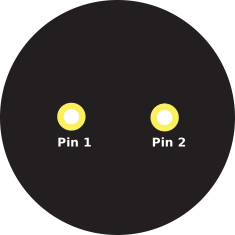
BUZZER
GMOD-BUZ-PIEZO — Piezo Buzzer
General-purpose piezo buzzer for audible alerts and tone generation in 3.3V and 5V microcontroller systems. Available in Active (fixed tone, digital ON/OFF) and Passive (variable pitch, PWM-controlled) variants. Compatible with direct GPIO drive on ESP32 and GLYPH-C6 platforms. Passive variant requires the ESP32 LEDC peripheral for PWM tone generation — Arduino
tone() is not supported on ESP32.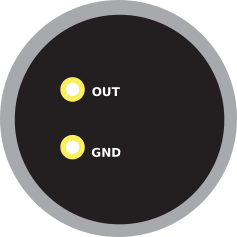
CONDENSER MIC
A compact electret condenser microphone that converts sound pressure into an analog electrical signal via an internal FET buffer. Bare capsules require a bias resistor and AC coupling capacitor to operate — output is in the mV range and must be amplified before reaching an ADC. For microcontroller use, opt for an amplified breakout module such as (manual gain) or (auto gain).
Battery Management1

Breakout3

Qwiic-2in1
I2C breakout board providing dual Qwiic JST-SH connectors for expanding a single I2C bus to two downstream Qwiic-compatible devices. Exposes GND, SCL, SDA, and 3V3 pins; operates at 3.3V logic and power, with no onboard IC or level shifting.

USB-C_Breakout_Module
# GMOD-USB-C — Description
The GMOD-USB-C is a compact passive breakout module that exposes the essential USB-C signals — VBUS (5V), D+, D−, CC1, CC2, and GND — to clearly labeled pads. Supporting USB 2.0 data (up to 12 Mbps) and up to 3A power delivery via CC configuration, it is ideal for USB-C power testing, signal probing, and embedded integration with GLYPH, Arduino, ESP32, STM32, and Raspberry Pi projects.

USB-TTL
USB-TTL is a serial interface module that converts USB signals to TTL-level UART, typically using a bridge IC such as the CP2102 or CH340. It exposes a USB-A or USB-C port on one side and a 3.3V or 5V TTL UART header (TX, RX, GND, and often VCC) on the other, supporting baud rates up to several Mbps. The module is powered directly from the USB bus and provides a regulated output for target devices.
Buttons & User Input7
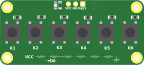
1x6 KEY ARRAY
# GMOD-BUTTON-1x6 — Description
The GMOD-BUTTON-1x6 is a compact analog input module with six tactile push buttons in a single row. Using a resistor-ladder network, all six buttons are read through a single ADC pin — each key producing a unique voltage level for software threshold detection. With zero idle power draw and no active components, it is ideal for menu navigation, control panels, and user interfaces in GLYPH'S, Arduino, ESP32, STM32, and other embedded applications.

CAP1203-TOUCH_SLIDER
CAP1203-based 3-channel capacitive touch controller with I²C interface and PWM output. Detects left, middle, and right touch/slide gestures with integrated debounce and signal processing. Operates over I²C with digital HIGH/LOW outputs per channel. Suitable for low-power, battery-operated applications.

Hot Swappable Key
Cherry MX mechanical keyboard switch with a 16.485 x 15.6 x 21.189 mm body and four pins. Pin 1 and pin 2 form the switch contact pair; pin 3 (LED_A) and pin 4 (LED_K) are the anode and cathode of the integrated LED. The footprint provides two through-hole pads and two SMD pads on the underside, plus three mounting holes.

PUSH BUTTON-12x12MM
12x12 mm through-hole tactile pushbutton switch with a 15.7 x 12.22 x 10.51 mm body and four pins. Pin functions and electrical ratings are not specified in the available data; refer to the linked KiCad footprint for authoritative contact configuration and rating information. Intended for momentary SPST switching in THT PCB assemblies.

PUSH BUTTON-6X6MM
6x6 mm through-hole tactile push-button switch with a 5 mm actuator height and 4 pins. Body dimensions are 8.5 x 6.5 x 5.93 mm. Electrical ratings and contact configuration are not specified here; refer to the linked datasheet for authoritative specifications.
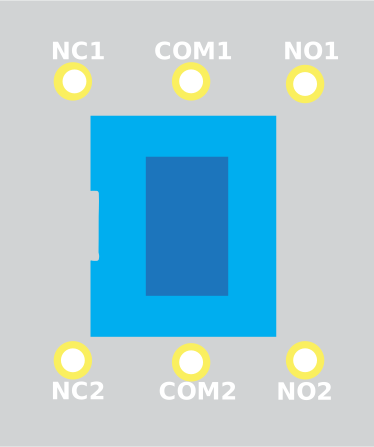
PUSH TO LOCK BUTTON
A mechanical momentary switch that closes or opens a circuit only while physically pressed — returning to its default state on release. Available in Normally Open (NO) and Normally Closed (NC) configurations. Always pair with a pull-up or pull-down resistor to avoid floating GPIO inputs. Debounce handling is mandatory in all digital applications — mechanical contacts bounce 1–10ms on every actuation.

Rotatory Endoder
Generic 5-pin incremental rotary encoder with pushbutton, 15 x 13.3 x 23 mm body. Exposes quadrature outputs CLK and DT, a momentary SWITCH contact, and VCC/GND supply pins; two additional pins (S1, S2) are defined in the source symbol.
Connector-rmc9

2 PIN JST RIGHT ANGLE
Right-angled JST 2-pin connector, 2.50 mm pitch, with a 7.72 x 8.91 x 4.2 mm body and two through-hole contacts. Exposes pin1 and pin2 on a 2-pin header interface; footprint pads are aligned to the JST EH S2B-EH horizontal 3D model. Manufacturer and exact ordering code are unspecified; electrical ratings must be confirmed against the purchased part.

JST 2 PIN CONNECTOR
JST 2-Pin Connector
A JST 2-pin connector is a compact, polarized wire-to-board connector used for simple low-voltage power connections in embedded systems and robotics.It is primarily used to supply power to modules, batteries, small motors, LED modules, and other peripheral devices where a secure, keyed, and vibration-resistant two-wire connection is required.

JST 3 PIN CONNECTOR
JST 3-Pin Connector
A JST 3-pin connector is a compact, polarized wire-to-board connector used for low-voltage power and signal connections in embedded systems and robotics.It provides power and a single control or data signal through one cable. Commonly used for servo motors, analog/digital sensors, addressable LEDs, and small peripheral modules requiring secure and vibration-resistant connections.

JST 4 PIN CONNECTOR
JST 4-Pin Connector
A JST 4-pin connector is a compact, polarized wire-to-board connector used for reliable low-voltage power and signal connections in embedded systems and robotics.It allows both power delivery and dual-signal communication through a single cable. Commonly used for I²C modules, sensors, motor drivers, encoders, and other peripheral devices requiring secure and vibration-resistant connections.

JST 5 PIN CONNECTOR
A JST 5-pin connector is a compact, polarized connector used for low-voltage power and multi-signal connections in electronic systems.
It typically carries VCC, GND, and three signal lines, making it suitable for communication interfaces, sensors, display modules, and robotics applications.

RIGHT ANGLE JST 3 PIN
A JST 3-pin right-angle connector is a compact PCB-mounted connector used to connect three wires, typically power, ground, and signal.
Its 90-degree design allows the cable to exit parallel to the circuit board, saving vertical space.
It is widely used in robotics, sensors, battery packs, and low-voltage electronic devices.

RIGHT ANGLE JST 4 PIN
A JST 4-pin right-angle connector is a compact PCB-mounted connector designed to connect four conductors, typically used for power, ground, and dual signal lines.
Its 90-degree orientation allows the cable to exit parallel to the PCB, minimizing vertical height and improving cable routing.
It is commonly used in sensors, display modules, communication interfaces, and embedded electronic systems.

RIGHT ANGLE JST 5 PIN
A JST 5-pin right-angle connector is a compact PCB-mounted connector designed to interface five conductors, typically used for power, ground, and multiple signal lines.
Its 90-degree orientation allows the cable to exit parallel to the circuit board, reducing vertical space and improving enclosure compatibility.
It is commonly used in display modules, communication interfaces, sensor arrays, and embedded electronic systems.

RIGHT ANGLED JST 2 PIN
A JST 2-pin right-angle connector is a compact PCB-mounted connector designed for two-wire connections, typically power and ground.
Its 90-degree orientation allows the cable to exit parallel to the circuit board, reducing vertical space.
It is commonly used in battery connections, small electronic devices, and low-voltage applications.
Connector-terminal-block2

2-Pin Screw Terminal Connector(pitch - 5.08mm)
2-Pin Screw Terminal Connector (Pitch – 5.08 mm)
A 2-pin screw terminal connector (5.08 mm pitch) is a PCB-mounted terminal block used for secure connection of power lines using screw-clamp wire retention.The 5.08 mm pitch provides adequate spacing for higher voltage and current applications. Commonly used for DC power input, battery connections, motor supply lines, LED power distribution, and industrial control wiring where strong, removable wire connections are required.

3-Pin Screw Terminal Connector(Pitch - 5.08 mm)
3-Pin Screw Terminal Connector (Pitch – 5.08 mm)
A 3-pin screw terminal connector (5.08 mm pitch) is a PCB-mounted terminal block designed for secure connection of higher-current or higher-voltage wires using screw clamps.The 5.08 mm pitch allows safe spacing for power and control lines. Commonly used in power input stages, relay modules, motor drivers, industrial control systems, and field wiring applications where reliable and removable wire connections are required.
Display & Visual9

0.91inch-OLED Display
0.91-inch monochrome OLED display module, 128x32 pixel resolution, 38 x 12 x 11.94 mm, 4-pin interface. Pin functions are not specified in the available data; consult the linked datasheet for pinout and electrical ratings.
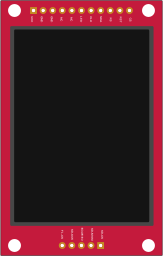
2.0 inch Color LCD
2.0-inch SPI TFT LCD color display module based on the ILI9225 controller, providing a 176 x 220 pixel active area with a serial interface. The module measures 42.7 x 67.44 x 15.82 mm and exposes 16 pins. Electrical ratings and interface timing are per the manufacturer datasheet.
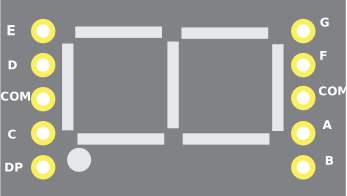
7 SEGMENT LED DISPLAY
A numeric LED display consisting of seven individually controlled segments (A–G) arranged to represent digits 0–9 and select characters. Available in Common Anode (CA) and Common Cathode (CC) variants — logic levels are inverted between the two. Always requires a current limiting resistor on each segment pin.

BLUE LED 5MM
A standard 5mm blue LED module compatible with 3.3V and 5V systems, consuming ~20mA. Ideal for status indication, debugging, and visual feedback in embedded projects.

GREEN LED 5MM
A standard 5mm GREEN LED module compatible with 3.3V and 5V systems, consuming ~20mA. Ideal for status indication, debugging, and visual feedback in embedded projects.
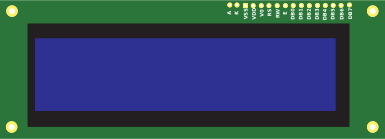
LCD DISPLAY 16*2
# 16×2 LCD Display Module (HD44780) — Description
The 16×2 Character LCD is a low-cost alphanumeric display module based on the HD44780 controller, capable of showing 32 ASCII characters (16 per line) in a 5×8 dot matrix format. Supporting 4-bit parallel, 8-bit parallel, and I²C communication (via PCF8574 backpack), it is widely used in embedded systems for user interfaces, real-time sensor readouts, and debug output with Arduino, ESP32, STM32, GLYPH, and other microcontrollers.
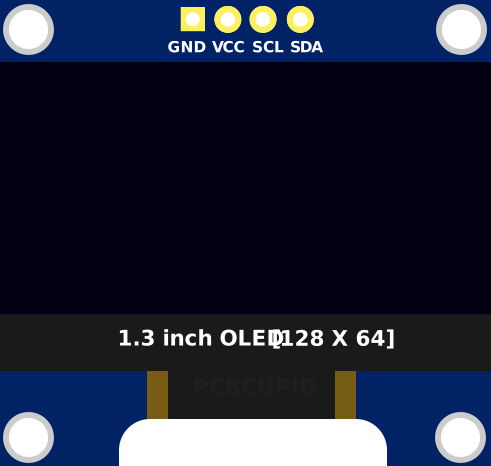
OLED Display
# GMOD-OLED-1.3-I2C — Description
The GMOD-OLED-1.3-I2C is a 1.3-inch 128×64 monochrome OLED display module with an I²C interface. Unlike LCDs, OLED displays use self-emissive pixels — eliminating the need for a backlight and enabling low power consumption, sharp text, and wide viewing angles. It is ideal for displaying sensor data, system status, menus, icons, and simple graphics in projects based on Arduino, ESP32, STM32, GLYPH, and other microcontrollers.

RED LED 5MM
A standard 5mm red LED module compatible with 3.3V and 5V systems, consuming ~20mA. Ideal for status indication, debugging, and visual feedback in embedded projects.

RGB-LED
RGB LED breakout with independent red, green, and blue channel pins for color mixing via PWM or digital control. Active-low logic, compatible with 3.3V and 5V systems. Requires external current-limiting resistors (100–330 Ω) per channel; supply voltage up to 5V, total draw 20–60 mA with all channels on.
Microcontroller6

Glyph C3
RISC-V microcontroller development board based on the ESP32-C3 SoC with a 160 MHz single-core processor, 400 KB SRAM, and 4 MB SPI flash. Provides 15 GPIOs with 12-bit ADC, I2C, SPI, UART, and USB serial, plus a USB-C port for power and programming. Includes a 3.3V regulator with 600 mA peak output, LiPo/Li-ion battery charger with auto-switching between battery and USB power, battery voltage measurement, and a Glink connector compatible with Qwiic/STEMMA QT. Features onboard LED on GPIO1, reset and boot buttons, and Wi-Fi/Bluetooth LE connectivity.

Glyph Mini RP2040
Compact RP2040 development board with dual-core ARM Cortex-M0+ at up to 133 MHz, 264 KB SRAM, and 8 MB SPI flash. Exposes 20 GPIOs with I2C, SPI, UART, and PWM support, plus USB Type-C for power and programming. Includes a QWIIC/STEMMA-compatible Glink connector, onboard status LED, and BOOT/RESET buttons. Powered via USB or external battery pads, with a 3.3V LDO regulator rated for 800 mA peak output.

GLYPH S3
ESP32-S3 development board with dual-core Xtensa LX7 MCU, Wi-Fi, Bluetooth LE, and AI acceleration. Exposes I2C, SPI, UART, ADC1 (9 channels), PWM, and GPIO via pin headers, plus a Qwiic/STEMMA-compatible Glink connector. Powered via USB-C (5V) or single-cell LiPo/Li-ion battery (2.7-4.2V) with automatic power switching and battery charging; 3.3V regulator output rated at 900mA peak.

Glyph-C6
ESP32-C6 development board with USB-C and single-cell LiPo/Li-ion battery power input, featuring automatic source switching and a 3.3V regulator with 600mA peak output. Exposes I2C (IO4/IO5), SPI (IO21/IO22/IO23), UART (IO16/IO17), six ADC channels (IO0-IO5), and PWM on all GPIOs. Includes a QWIIC/STEMMA-compatible Glink connector, battery voltage measurement via shortable MSR pads, and strapping pins on GPIO8/GPIO9 for boot mode control.

Glyph-H2
RISC-V microcontroller development board based on the ESP32-H2 SoC, featuring a 96 MHz single-core processor, 320 KB SRAM, and 4 MB SPI flash. Exposes 19 GPIOs with 12-bit ADC, I2C, SPI, UART, and USB serial, plus a GLINK connector for QWIIC/STEMMA QT compatibility. Includes USB-C for power and programming, a 3.3V regulator with 600 mA peak output, and a built-in LiPo/Li-ion charger with battery measurement and auto-switching between battery and USB power. Supports Bluetooth LE, Zigbee, and Thread via the certified wireless module.

Glyph-RP2040
RP2040 breakout board with dual-core Arm Cortex-M0+ at up to 133 MHz, exposing 26 GPIOs supporting SPI, I2C, UART, PWM, and 4-channel 12-bit ADC. Integrates MCP73831 Li-Po charger (4.2 V) and LDO for 3.3 V rail from USB (4.5–5.5 V) or single-cell battery (3.0–4.2 V). Provides SWD debug (SWCLK/SWDIO), reset, VBUS, +BATT, and L_EN enable pins; GPIO logic is 3.3 V only, LDO limited to ~300 mA.
Module14
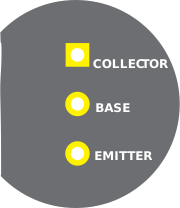
BC547
A general-purpose NPN BJT in a TO-92 package, designed for low-power switching and small signal amplification. Turns ON when the Base is driven HIGH relative to the Emitter — always requires a base resistor. Rated at 100mA collector current and 500mW max dissipation. Available in three gain groups — A, B, and C.

BI-VOLTAGE-LEVEL-TRANSLATOR
4-channel bidirectional voltage level translator module for interfacing logic between two power domains (e.g., 3.3V and 5V). Uses an N-channel MOSFET open-drain topology with on-board pull-up resistors, providing automatic direction sensing without control pins. Exposes low-voltage side (VCC, A1–A4) and high-voltage side (VDD, B1–B4) with dual common ground pins. Supports I²C, UART, SPI, and other mixed-voltage signals.
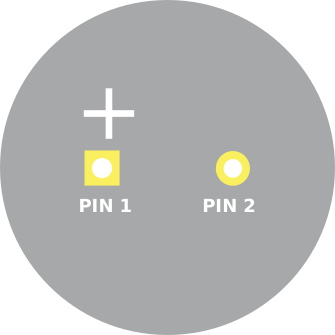
CAPACITOR
A passive two-terminal component that stores energy in an electric field. Blocks DC, passes AC — used for decoupling, filtering, timing, and energy storage. Comes in ceramic, electrolytic, tantalum, and film types. Key parameters: capacitance, voltage rating, ESR, polarity, and temperature coefficient.

DIODE
Passive two-terminal semiconductor device that permits current flow in one direction only, used for rectification, reverse polarity protection, voltage clamping, and freewheeling across power and signal circuits.

IN4148 Diode
The 1N4148 is a small-signal silicon switching diode in a through-hole package measuring 9.22 x 2.24 x 4.14 mm with two axial pins (anode and cathode). It is used for high-speed switching, signal rectification, and clamping, with typical ratings of 100 V peak reverse voltage, 200 mA forward current, and a fast reverse recovery time in the low nanosecond range. Electrical characteristics not listed here should be taken from the manufacturer datasheet.
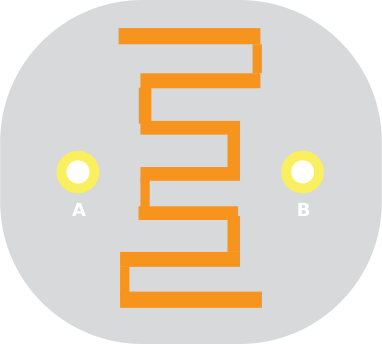
LDR
A passive light-sensing component whose resistance decreases as light intensity increases. Non-polarized and analog by nature — always used in a voltage divider to produce a readable output voltage. Best suited for simple ambient light detection, automatic switching, and brightness control.

LIMIT SWITCH
A limit switch is an electromechanical device used to detect the presence, absence, or position of an object through physical contact. It is widely used in industrial machinery, robotics, CNC machines, and automation systems to control movement, prevent over-travel, and provide position feedback. Compatible with all GLYPH boards via a simple 3-pin (S, G, V) interface.
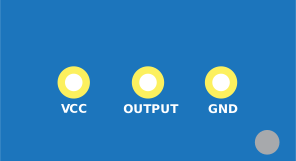
POTENTIOMETER TRIMMER
A trimmer potentiometer (preset resistor) is a small adjustable variable resistor designed for fine calibration on printed circuit boards. It is typically adjusted using a screwdriver and is used to set voltage levels, gain, or offset values in electronic circuits. Trimmers are available in single-turn and multi-turn versions for different precision requirements.

POTENTOMETER 90 DEGREE
A 90-degree rotary potentiometer is a variable resistor that provides adjustable resistance over a limited 90° mechanical rotation range.
It is commonly used for precise position sensing, calibration adjustments, and control inputs in embedded systems and analog circuits.
The device typically features three terminals (VCC, GND, and Wiper) and outputs a variable voltage proportional to the shaft position.
RESISTOR
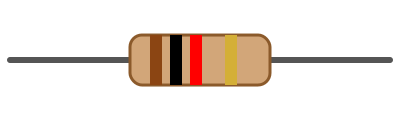
Resistor – Description
A resistor is a passive electronic component that limits or controls the flow of electric current in a circuit. It provides a specific resistance value (measured in ohms, Ω) to regulate voltage and current levels, protecting components and ensuring proper circuit operation.

RGB LED
A single LED package containing three independent Red, Green, and Blue channels capable of producing the full visible color spectrum through additive PWM mixing. Available in Common Anode and Common Cathode configurations — control logic is inverted between the two. Each channel has a different forward voltage and must have its own independently calculated current limiting resistor. For addressable multi-LED setups with built-in driver ICs.
ROTARY ENCODER
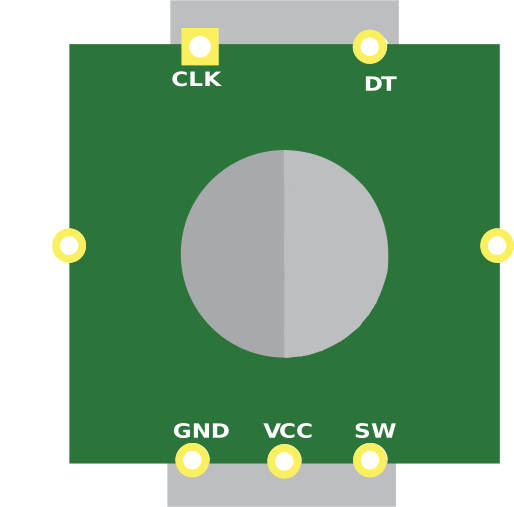
# GMOD-ROTARY-ENCODER — Description
The GMOD-ROTARY-ENCODER is a compact 5-pin incremental rotary encoder module featuring quadrature A/B output (CLK, DT) for rotation and direction detection, plus an integrated push button (SW) on the shaft for click input. Compatible with 3.3V and 5V logic systems, it connects directly to GLYPH, Arduino, ESP32, STM32, and Raspberry Pi via GPIO — ideal for menu navigation, parameter adjustment, relative position tracking, and user interface control in embedded and DIY electronics projects.

RTC-MCP
I²C real-time clock module based on the Microchip MCP79412 RTCC, providing timekeeping with battery backup via a CR1220 cell, two programmable alarms, power-fail timestamping, 64 bytes SRAM, 1 Kbit EEPROM, and a factory-programmed unique ID. Operates at 1.8V–5.5V with a 400 kHz I²C interface, and is compatible with Arduino, Raspberry Pi, and IoT projects.

RTC-PCF
PCF8563 RTC module with I2C interface (up to 400 kHz) for timekeeping, alarms, and countdown timer. Operates from 1.0V to 5.5V with typical current under 1 µA in time-keeping mode. Exposes VCC, GND, CLK, SDA, SCL, and interrupt pins. Includes programmable clock output and automatic leap year correction.
Power Switching & Isolation6

1 ch Relay
Single-channel relay module with optocoupler isolation for switching one high-power AC or DC load via a low-voltage control signal. Exposes VCC, GND, and a single IN control pin, plus COM, NO, and NC switching terminals. Operates at 5V coil voltage and is compatible with 3.3V or 5V logic levels.
BI-VOLTAGE-LEVEL-TRANSLATOR
4-channel bidirectional voltage level translator module for interfacing logic between two power domains (e.g., 3.3V and 5V). Uses an N-channel MOSFET open-drain topology with on-board pull-up resistors, providing automatic direction sensing without control pins. Exposes low-voltage side (VCC, A1–A4) and high-voltage side (VDD, B1–B4) with dual common ground pins. Supports I²C, UART, SPI, and other mixed-voltage signals.

DC-DC-BOOST
DC-DC boost converter module stepping up a DC input to a higher regulated output. Exposes four through-hole pins: IN, GND (×2), and OUT. Includes onboard switching regulator, input/output capacitors, and an indicator LED.

DC-DC-BUCK
Compact step-down DC-DC buck converter module based on the SY81103 synchronous regulator IC. Accepts 4.5V–18V DC input and provides a fixed, non-adjustable regulated output (voltage per unit labeling) via through-hole IN/GND/OUT/GND pins. Includes input/output filtering, inductor, status LED, and screw terminal for input wiring.

LimitSwitch
Electromechanical limit switch module for end-of-travel and position detection, exposing a single digital signal pin (S) alongside VCC and GND. Integrates with Glyph ESP32 boards via GPIO with internal pull-up; output is active-low when actuated. Operates as a normally open contact, rated for logic-level switching.

Relay-2ch
2-channel relay module for switching two independent high-voltage AC/DC loads via low-power control signals. Uses two optocouplers for electrical isolation between the control and relay circuits, with a 5V supply and separate IN1/IN2 control pins. Each channel exposes COM and NO switching terminals, activated by a HIGH signal (3.3V/5V) and deactivated by LOW.
Protocol Converter1

Sensor7

BC-557
The BC557 is a widely used, general-purpose PNP bipolar junction transistor (BJT) housed in a TO-92 package. Primarily used for switching and amplifying, it features a continuous collector current and a high DC current gain (up to 800). It is commonly used in low-power audio circuits and signal processing.
CAP1203-TOUCH_SLIDER
CAP1203-based 3-channel capacitive touch controller with I²C interface and PWM output. Detects left, middle, and right touch/slide gestures with integrated debounce and signal processing. Operates over I²C with digital HIGH/LOW outputs per channel. Suitable for low-power, battery-operated applications.

DHT11
The DHT11 is a low-cost digital sensor used to measure temperature and relative humidity.
It features a built-in capacitive humidity sensor, thermistor, and single-wire digital output, making it easy to interface with microcontrollers like Arduino and ESP32.
hall sensor
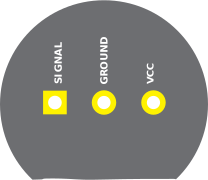
A Hall effect sensor is a solid-state device that detects the presence and strength of a magnetic field. Unlike mechanical switches, it works without physical contact, making it incredibly durable and resistant to wear.

IMU42670
9-axis IMU module based on the TDK InvenSense ICM-42670-P, providing 3-axis accelerometer, 3-axis gyroscope, and temperature sensing. Interfaces via I2C (up to 1 MHz) or SPI (up to 24 MHz) with selectable accelerometer ranges (±2g to ±16g) and gyroscope ranges (±15.625 to ±2000 dps). Operates at 3.3V with output data rates up to 32 kHz and includes interrupt and frame sync pins.

QMC6309
QMC6309 is a 3-axis digital magnetometer IC from QST Corporation with an I²C interface and 16-bit ADC resolution. It operates from a 2.5 V to 3.6 V supply, drawing approximately 2 mA, and includes built-in self-test functionality. The module exposes VCC, GND, SDA, and SCL pins for direct MCU integration, making it suitable for orientation tracking and magnetic field sensing in embedded applications.

ULTRASONIC SENSOR HC-SR04
HC-SR04 Ultrasonic Sensor Expert
An AI assistant specialized in the HC-SR04 ultrasonic distance sensor. It helps with wiring, code (Arduino, Raspberry Pi, ESP32, MicroPython), distance calculations, troubleshooting, and project integration — across all common microcontroller platforms.
Storage2

FLASH-MEMORY
Serial flash module providing non-volatile storage for microcontrollers via SPI/QSPI interface. Exposes VCC, GND, CLK, CS, MOSI, MISO, and optional IO2/IO3 data lines for quad-mode operation. Supports firmware storage, OTA updates, data logging, and configuration management with sector/block erase and execute-in-place capability. Operates at 3.3V with low power consumption and high endurance.

MicroSD
MicroSD card module for Glyph ESP32 boards, interfacing over SPI for file read/write, data logging, and asset storage. Exposes 3V3, GND, SCK, MO, MI, CS, D1, and D2 pins; supports SPI and SDIO modes, with push-push socket and FAT file system compatibility.
Wireless Modules2

TERRALINK EC200U
Industrial evaluation board for the EC200 cellular module, exposing its UART interface (G_TX, G_RX), reset (RST_KEY1), and power key (PWR_KEY1) via a 5-pin 2.54 mm header, plus a 2-pin screw terminal for field wiring. Designed for RS-485, CAN, and Modbus-based applications; no onboard power regulation, requiring a stable 3.4–4.2 V DC supply with up to 2 A peak current. All signal pins are directly connected to the module without level shifting.

terralink-a7672s-ek
Industrial LTE Cat 1 evaluation board built around the SimCom A7672S module (ARM Cortex-A5, 256 MB DDR2, 4 GB eMMC). Exposes RS-485, CAN, Modbus, three UARTs (main AT, auxiliary, debug log), SPI, I2C, USB, and six GPIOs via a 7-pin 2.54 mm through-hole header with 3.3V logic. Supports LTE-FDD/LTE-TDD/GSM/GPRS with peak downlink 10 Mbps and uplink 5 Mbps, plus built-in TCP/UDP/IP stacks. Powered via dedicated input or USB, with onboard 3.3V regulation.